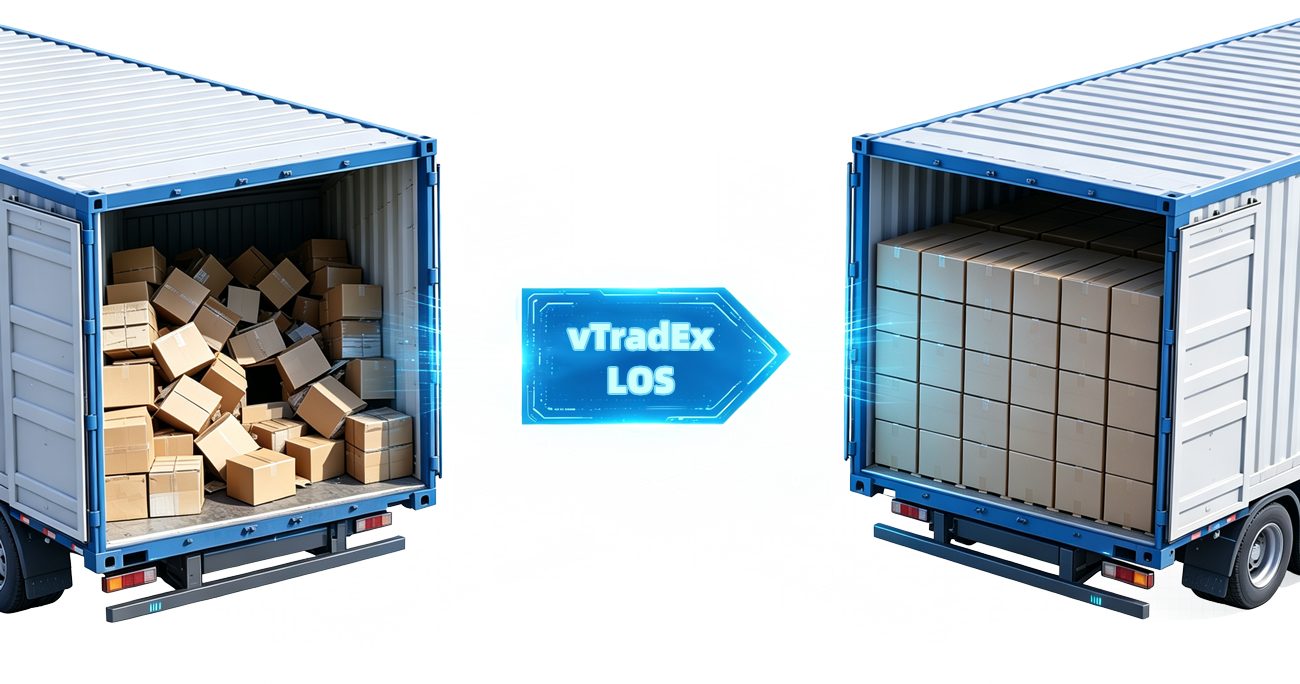
What is LOS ?
To solve problems such as low manual loading efficiency, insufficient space utilization, and high risk of cargo damage, it uses intelligent algorithms to automatically generate optimal loading plans, improves the space utilization of vehicles and containers, reduces transportation costs, standardizes the loading process, ensures transport safety, and makes loading operations standardized, intelligent, and efficient. Working in coordination with warehousing and transportation systems, it improves overall logistics operating efficiency.
vTradEx Loading Optimization System
Use Cases
Road FTL (full truckload) / LTL (less-than-truckload) transportation
Container ocean shipping
Air cargo palletization (ULD build-up)
Rail freight
Warehouse pallet stacking
Finished-goods outbound loading at the factory
Multiple Loading Scenarios
Single SKU, single container: calculate the maximum quantity of one product specification that fits in a single container.
Single SKU, multiple containers: calculate the maximum quantity of one product specification that fits in containers of different types.
Multiple SKUs, single container: determine whether a single container can hold the specified quantities of goods.
Multiple SKUs, multiple containers: with multiple product specifications and multiple container types, determine which containers are more suitable for loading the goods and how many containers are needed in total.
Powerful Integration Capabilities
Direct integration with vTradEx WMS and TMS on a unified framework
Connect with any system through any API to achieve information coordination across packing, tallying, and transportation, greatly improving handover efficiency
The API provides loading result data, loading result thumbnails (loading diagrams), and loading guidelines
Support for All Kinds of Containers
We use the word "container" to refer to anything that can hold other items. A container can be a standard shipping container, a truck, a flatbed trailer, a pallet, or a carton.
LOS - An In-House Product within the vTradEx Logistics Product Chain
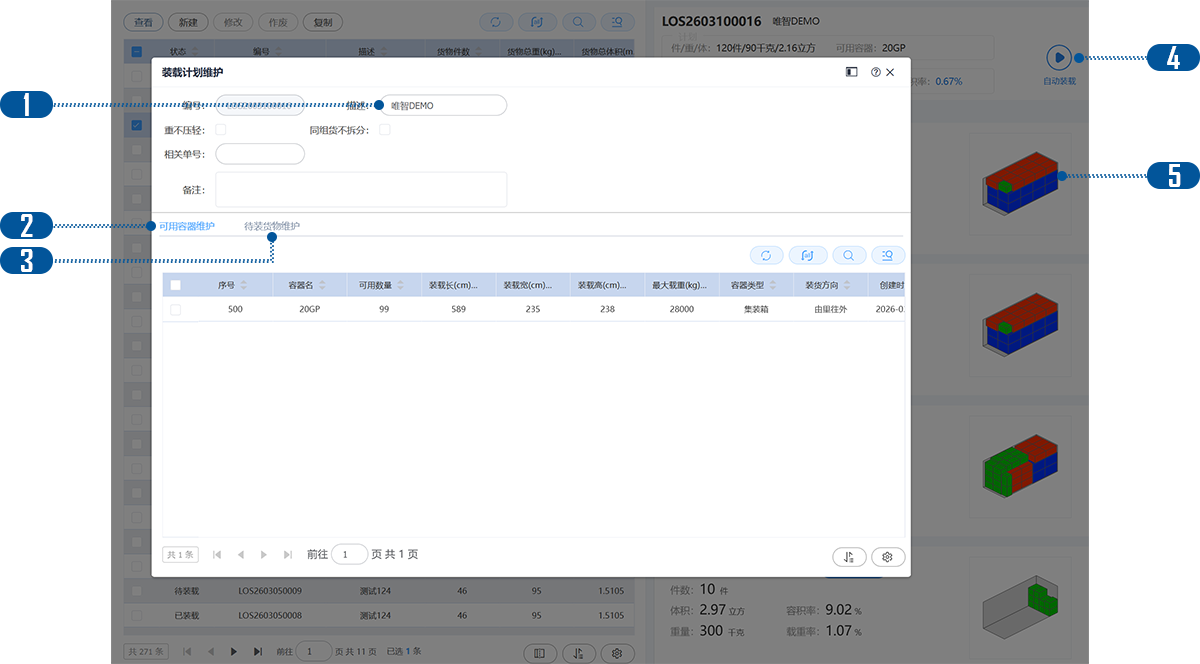
How to use ?
To create a loading plan, simply:
① Enter a name for the loading plan
② Add containers
③ Add goods
④ Click Optimize
⑤ View the loading results